The Southwest Script
The Almodôvar municipality holds the trail of the oldest writing in the Iberian Peninsula: the Southwest Script, carved on stone stelae between the 8th and 5th centuries BC and still undeciphered today. One of those stelae was found at Mesas do Castelinho, a stone's throw from Santa Clara-a-Nova.
A script no one can read
The oldest writing system in the Iberian Peninsula
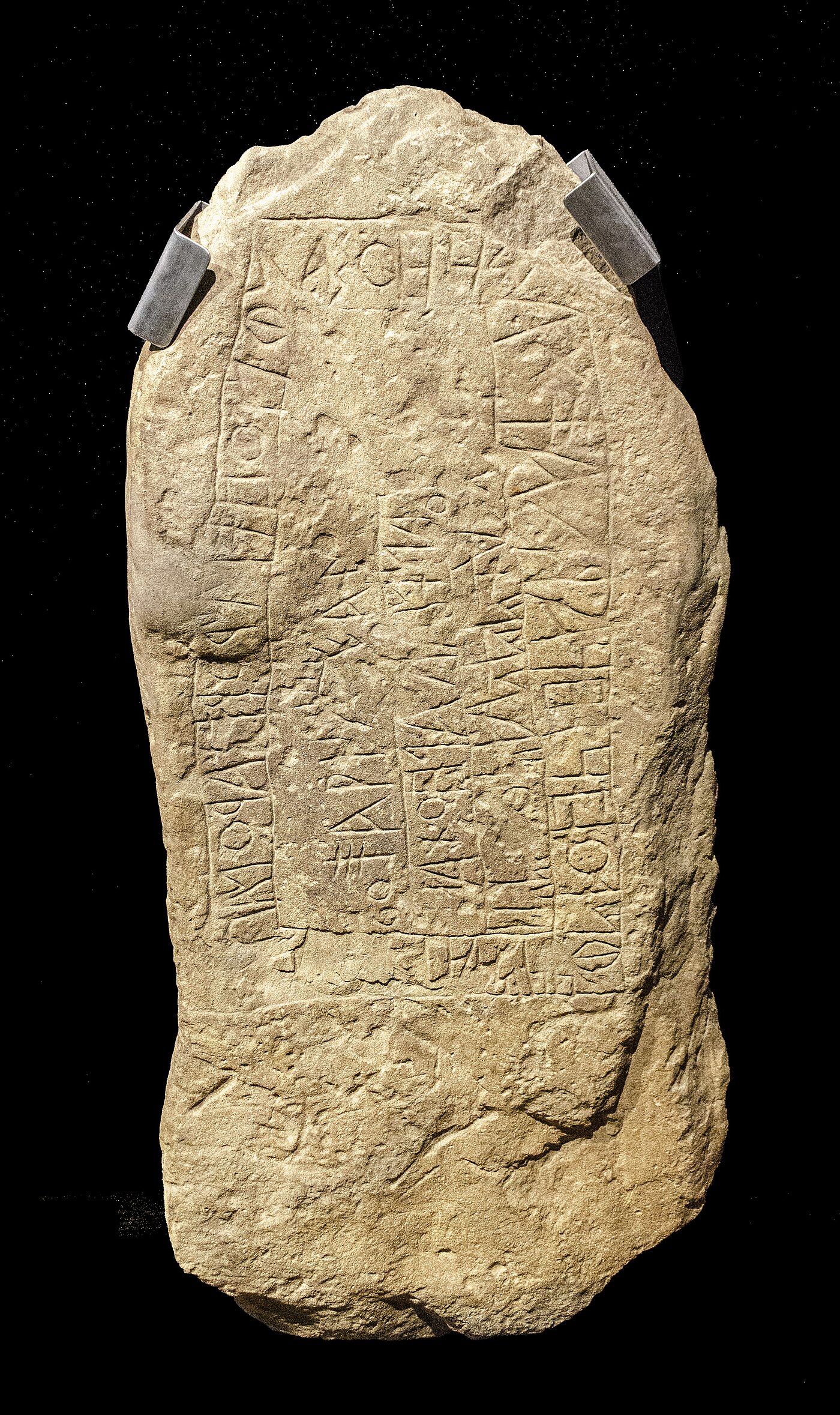
The Southwest Script (Escrita do Sudoeste), also known as the Tartessian script, is considered the oldest writing system in the Iberian Peninsula. It dates from the 8th to the 5th centuries BC and remains undeciphered to this day, one of the great mysteries of European archaeology.
The known remains are found mostly on stone stelae discovered in southern Portugal and southwestern Spain. They are believed to be funerary stelae, gravestones marking burials. But until the signs are deciphered, no one knows for certain what they say.
The Mesas do Castelinho stela
Spotted in 2007, lifted in September 2008
The block was spotted at the end of the 2007 campaign, in Rua 1 of Sector B3 at Mesas do Castelinho, and was not lifted until September 2008. No publication gives an exact day for the find.
It had been reused face down in a fill preparing the circulation surface of a Roman Republican street, not in the street paving itself. The inscription is roughly three centuries older than the surface it lay in, its original location is unknown, and the excavators judged it of little value for dating the settlement. In a survey of 28 stelae from excavated contexts, this is the only one ever found reused in a road fill.
It measures 112 × 51 × 9 cm and carries 82 signs, 80 of them of identifiable phonetic value and 21 distinct: the longest known text in this script. It is one of the most valuable finds from the archaeological site and directly links Santa Clara-a-Nova to this mysterious chapter in the history of writing in the Iberian Peninsula.
MESA: Museum of the Southwest Script
The reference museum, in Almodôvar
The reference museum for this script is in Almodôvar, about 15 km from Santa Clara-a-Nova. Housed in the town's former Cine-Teatro on Rua do Relógio, MESA presents a collection spanning 2,500 years of the history of writing in this territory. According to the museum, it brings together 16 of the roughly 90 epigraphed stelae known in the Iberian Peninsula.
MESA offers guided visits, a shop and access for people with reduced mobility.
| Address | Rua do Relógio, 7700-065 Almodôvar |
| Opening hours | Daily, 10:00-13:00 and 14:00-18:00 (except public holidays) |
| Phone | +351 286 665 357 |
| mesa@cm-almodovar.pt | |
| Services | Guided visits, shop, reduced-mobility access |
The terracotta head
Among the finds from Mesas do Castelinho is a small terracotta human head, found in 1995 in Sector A1, in secondary position in an Iron Age context. It has realistic features and is possibly a child; the excavation team calls it "Batata", Potato. The only archaeologist to publish on it reads it as "a toy, or even a decorative object", and writes explicitly that it does not seem to her to represent a divinity or an ex-voto. The "cultural synthesis" reading of Mediterranean and Celtic traits, which circulates in popular material, has no support in archaeological publication.
In short
- ◆Considered the oldest writing in the Iberian Peninsula (8th to 5th centuries BC)
- ◆Remains undeciphered to this day
- ◆The stelae are believed to be funerary
- ◆Found in southern Portugal and southwestern Spain
- ◆At Mesas do Castelinho, a stela was spotted in 2007 and lifted in September 2008, reused face down in a fill beneath a Roman street
- ◆According to the museum, MESA holds 16 of the roughly 90 epigraphed stelae known in the Iberian Peninsula
The Lizard-Man Legend
The other mystery of Mesas do Castelinho: an enchanted house, a treasure and a guardian half man, half lizard.
Read the legend